How often thermal paste actually needs replacing
Thermal paste does not need changing on a schedule. The only reliable indicator that a repaste is overdue is a sustained rise in interface temperature—because the paste layer between a chip and its cooler is never truly static, and the forces that degrade it operate on cycles of heat, not pages of a calendar.
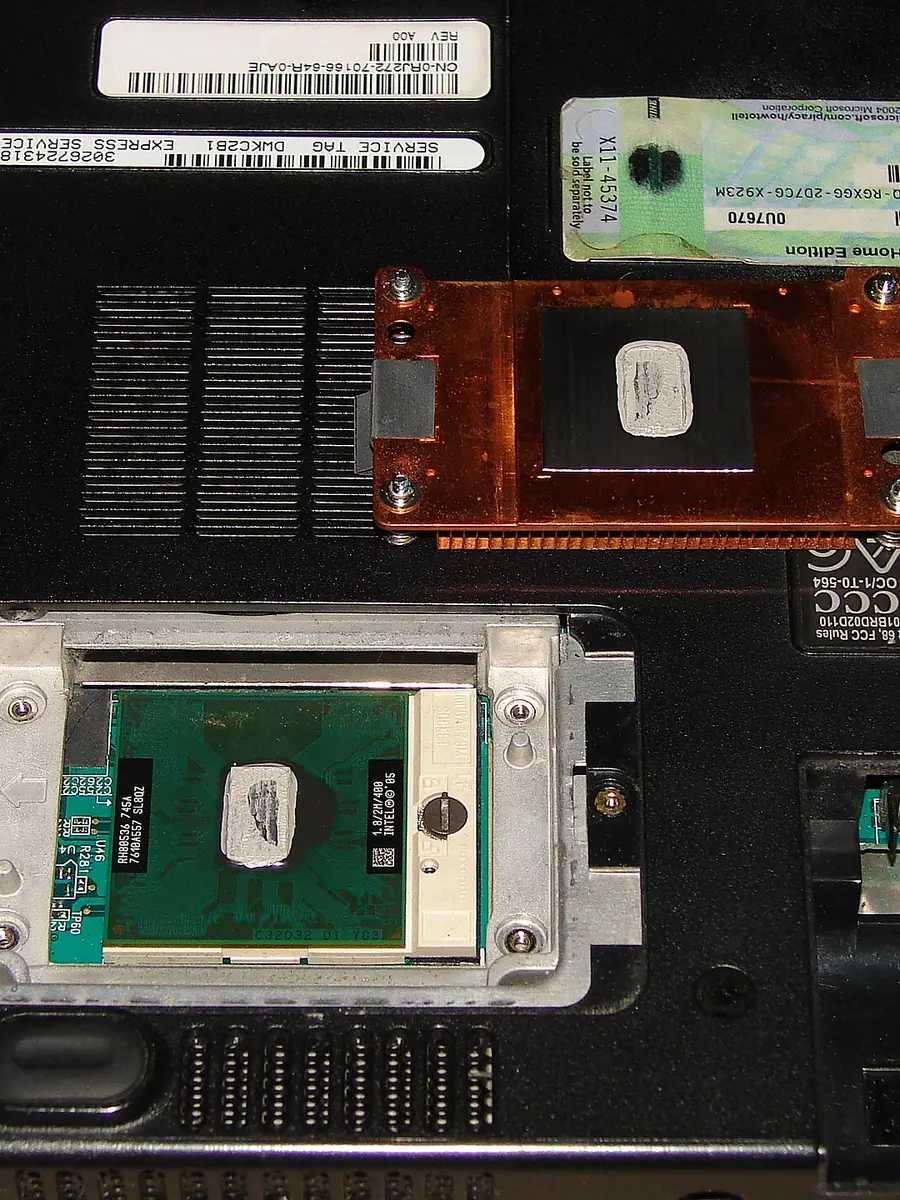
The paste begins its working life unevenly. After mounting, it must be thermally cycled before it distributes into its final, thin film. Danfoss describes thermal cycling as raising the heatsink temperature from room temperature, about 20°C, to 90±10°C and back to room temperature three times. Skip those cycles and the bond that looks adequate at first power-on may be nothing of the sort once the system has run a real workload.
The real failure driver is thermal cycling
That same heating and cooling that lets paste settle into place is also what eventually pushes it out. Every rise and fall in temperature causes the heatsink baseplate and the chip package to expand and contract at different rates. Danfoss documents a pumping action that results from this differential movement, progressively squeezing paste from beneath the module. What began as a continuous film becomes a thinned, uneven layer, and thermal resistance climbs. Migration, the term the guide uses, is not a chemical breakdown but a mechanical displacement; paste literally walks out of the gap.
The mechanism is separate from the simple drying out that many users assume is the only failure mode. Pump-out can occur long before the binder in a paste has lost its plasticisers. The frequency and severity of temperature swings—how many times the chip goes from idle to full load and back—matters far more than how many months have elapsed since assembly.
How compound makers fight back
Manufacturers engineer against these effects from the start. A Farnell datasheet for a typical thermal interface material lists pump-out resistance, low outgassing, and resistance to phase separation among the compound’s design targets. The material is not a passive goo; it is formulated to stay put. Achieving that requires correct installation. That same datasheet specifies a continuous mounting pressure of at least thirty kilopascals to fully mate the surfaces, and it instructs that the assembly should be thermally cycled above fifty degrees Celsius to cure the paste and activate its phase-change properties.
Thickness is the other variable that determines whether those built-in protections work. An Infineon-associated mounting instruction says the recommended thermal paste thickness is 80–100 µm. Thicker than that and the thermal resistance rises needlessly; thinner, and the compound cannot accommodate the surface roughness of the two mating parts, leaving air pockets. Getting the right film thickness is a matter of clamping force, paste volume, and the flatness of the surfaces, and it explains why two machines assembled with the same paste can age at completely different rates.
Signs the interface is losing its grip
A failing thermal joint announces itself in rising operating temperatures for the same workload. Fuji Electric’s mounting instructions warn that if the amount of paste is insufficient or the application method is unsuitable, spreading will be inadequate and thermal conductivity will worsen. The performance drop may not be immediate; an interface that was marginal at the time of assembly can degrade quietly until the chip repeatedly nudges its thermal throttle point.
The same instructions caution that power-cycle capability decreases when an improper paste is used in high-temperature operation, owing to deterioration or depletion of the compound. Depletion here means exactly what the Danfoss documents describe: the physical loss of material from the gap. A chip that once handled a given load at a stable temperature now spikes higher and recovers more slowly. That is the signal to act.
Metal versus polymer: a fundamental split
The vulnerability of a paste to pump-out and drying out depends heavily on its chemistry. Indium’s technical overview of thermal management materials draws a clean line: metal interface materials contain none of the fluid components found in polymeric compounds, making them effectively insensitive to pump-out and to the gradual evaporation that hardens silicone- or hydrocarbon-based greases. A polymer paste relies on a liquid carrier that eventually migrates or volatilises; a pure metal pad or malleable foil starts with no fluid to lose. The trade-off is that metal materials demand flatter surfaces and higher clamping forces, and they are far less forgiving of assembly mistakes.
For the vast majority of consumer machines, polymeric paste is what the factory used, so the dominant long-term risk is the one Danfoss describes. That risk is not uniform—some polymer formulations claw back fluid from the surface when cool, partly refilling the gap; others do not, and the interface permanently deteriorates.
Replacement is a measurement, not a schedule
Since failure is mechanical and thermal, not chronological, the only honest maintenance answer is to watch the numbers. Danfoss requires checking paste distribution and thermal performance only after cycling, not on a date. Fuji Electric ties performance warnings to operating conditions, not to months in service. Indium’s metal materials further illustrate the point: with no fluid to lose, the interface can remain stable for the useful life of the hardware, provided it was mounted correctly.
The practical rule follows from these diverse sources: if the temperature of the chip under a fixed, repeatable load has not risen since the system was built or last cleaned, there is nothing to fix. If the paste has pumped out or dried to the point where thermal resistance has climbed measurably, repaste. No manufacturer’s documentation supports a universal yearly or biennial renewal cycle; the variables of mount quality, operating temperature range, and compound formulation swamp any generic interval. Monitoring the thermal margin, not the calendar, is what separates needless maintenance from the moment a repaste actually matters.